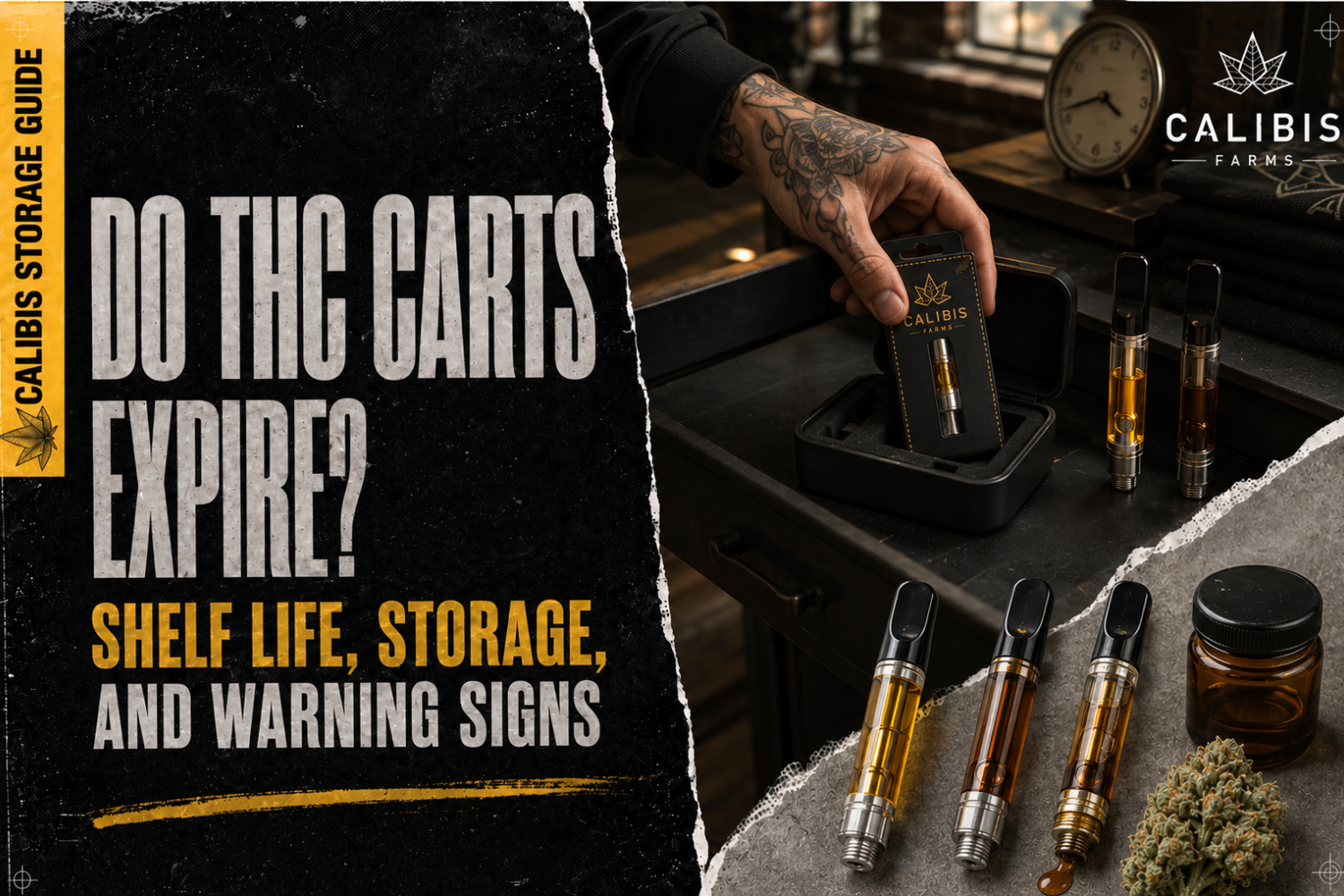
Do THC carts expire? Yes. A THC cartridge does not stay at peak quality forever, even when it remains unopened. Cannabinoids and terpenes can change over time, while heat, light, air, moisture, and damaged hardware can accelerate the decline. An older cartridge may lose aroma, flavor, consistency, or potency before it develops an obvious defect.
There is no single expiration period that applies to every cartridge. The oil formula, terpene content, manufacturing process, hardware, packaging, and storage history all matter. The most reliable approach is to follow the date and storage directions on the original package, inspect the cartridge before use, and avoid any product that is damaged, leaking, contaminated, or from an unlicensed source.
Table of Contents
Do THC Carts Expire or Simply Lose Quality?
People often use “expire” and “go bad” to describe several different changes. A cartridge may still look normal but no longer deliver the aroma or flavor it had when fresh. Another cart may have a physical problem, such as a cracked tank, a failed seal, corrosion, or a leak. These situations are not equivalent, but both are reasons to evaluate the product carefully.
Time can alter cannabis oil. Research on stored cannabis has found that light, oxygen, temperature, and storage duration influence cannabinoid stability. THC may gradually degrade while oxidation products such as CBN increase. Terpenes are volatile aromatic compounds, so their profile can also shift or diminish during storage. This evidence helps explain why the answer to “do THC carts expire?” involves more than the printed date.
Those studies help explain why careful storage matters, but they do not create a universal expiration date for every retail vape. A finished cartridge is a system made from oil, seals, a heating element, a mouthpiece, and other materials. The condition of that entire system matters—not just the age of the oil.
How Long Do THC Carts Last?
When shoppers ask how long a cart lasts, they may be asking two different questions. Usage life means how many sessions or inhalations a cartridge may provide. That depends on cartridge size, device settings, and individual use. Shelf life means how long the unopened or opened product can retain acceptable quality under the manufacturer’s recommended conditions.
No responsible answer can assign one exact shelf life to all cartridges. Formulas vary, and a cart kept inside its box in a cool, dark cabinet has a different storage history from one left in a hot car or on a sunny windowsill. The package is therefore more useful than a generic date found online.
Check the original label for the manufacturing or packaging information, batch or lot identifier, and any best-by, use-by, or expiration guidance supplied by the producer. If the manufacturer gives a storage window, follow it. When a date is missing or unclear, contact the licensed retailer or manufacturer rather than guessing.
Do THC Carts Expire Faster After Opening?
An unopened cart in intact original packaging generally has better protection from light, air, dust, and handling. Once the product is opened and attached to a battery, it experiences more temperature changes, movement, and exposure. Residue can collect near the mouthpiece, and repeated heating can affect the remaining oil. For anyone asking “do THC carts expire faster after opening?”, opening creates more opportunities for quality loss, although the exact rate still varies.
Unopened does not mean immune to aging. Packaging cannot protect a cartridge that has been stored for long periods in excessive heat or direct sunlight. Likewise, a recently opened cart may need to be discarded if the glass is cracked, the seal fails, or the oil appears contaminated.
What Changes Inside a THC Cartridge Over Time?
Cannabinoids can degrade
THC is not perfectly stable. Scientific storage studies show that its concentration can decline with time and that temperature, light, and oxygen affect the rate of change. This is one reason an old, poorly stored cart may not perform like it did when new.
Age alone cannot tell a consumer the cartridge’s current cannabinoid content. Only appropriate laboratory analysis can measure the oil accurately. Avoid estimating potency from color, thickness, aroma, or a single test inhalation.
Terpenes may lose freshness
Terpenes create much of the recognizable aroma and flavor associated with a cannabis vape. Because many terpenes are volatile and sensitive to storage conditions, the profile may become flatter, harsher, or simply different over time. A study of postharvest cannabis storage found that terpenoid content changed under the tested conditions. Heat and repeated exposure to air can make this change more noticeable.
Readers who want to understand these aromatic ingredients can explore our guide to cannabis-derived terpenes and our comparison of botanical and cannabis terpenes.
Oil consistency and appearance may shift
Cannabis oil can darken as it ages or after repeated heating. Temperature also changes viscosity: cold oil tends to move more slowly, while warm oil flows more easily. Some formulations may naturally show crystallization or separation. These observations can offer context, but none is a reliable safety test by itself.
A mild color change does not automatically prove that a cart is unsafe, and a clear-looking cart is not automatically safe. In other words, the question “do THC carts expire?” cannot be answered by color alone. Compare the product with its original appearance when possible, follow manufacturer guidance, and consider the label, storage history, aroma, seals, and hardware together.
Hardware can fail before the oil does
A cartridge contains several components that can deteriorate or become damaged. Seals may loosen, the tank may crack, the mouthpiece may clog, and metal parts may corrode. A leaking cart can expose the oil to contaminants and make contact with the battery unsafe. Do not attempt to repair, refill, or heat a damaged cartridge unless its manufacturer specifically provides a safe procedure.
Do THC Carts Expire? Warning Signs to Check
If you are deciding whether an older cart is still suitable, begin with the package and a visual inspection. Do not taste or inhale an unknown product simply to test it. Stop and follow the manufacturer’s instructions if you notice any of the following:
- A best-by or expiration date has passed, or the producer advises against further use.
- The cartridge is cracked, chipped, leaking, swollen, corroded, or has a loose mouthpiece or seal.
- The oil contains unfamiliar particles, cloudiness, or signs of contamination that were not part of the original product.
- The aroma is rancid, chemical-like, burnt, or substantially different from when the cart was new.
- The product has been stored in a hot vehicle, direct sun, excessive moisture, or another condition outside label instructions.
- The package is missing, altered, unsealed, or cannot be connected to a licensed California producer and retailer.
- The device overheats, activates unexpectedly, sparks, or shows battery damage.
Clogging, darker oil, or thicker oil can occur for more than one reason, so those signs require context. However, uncertainty is itself a reason to pause. A cartridge is not valuable enough to justify using a product with unknown origins, damaged hardware, or questionable storage.
Can You Use an Expired THC Cart?
The safest answer is to follow the product label and manufacturer. If a stated date has passed, the manufacturer says not to use it, or the storage history cannot be verified, replace the cartridge. Never assume that reheating, mixing, transferring, or diluting old oil will restore its original quality or make a questionable cart safe.
An expiration date does not diagnose contamination, and appearance cannot rule contamination out. If someone experiences chest pain, breathing difficulty, severe vomiting, confusion, loss of consciousness, or another serious reaction after vaping, stop use and seek urgent medical help. Keep the package available so medical professionals can identify the product.
California consumers should purchase cannabis only from licensed retailers. Our cannabis vape guide explains how to review labels, hardware, testing, and licensed sources before choosing a product.
Do THC Carts Expire Faster with Poor Storage?
Good storage cannot stop aging completely, but it can reduce avoidable exposure. When people ask “do THC carts expire even with careful storage?”, the answer remains yes: proper storage slows avoidable change but does not preserve a cart indefinitely. Always prioritize the instructions printed on the product or provided by the manufacturer.
Keep the cartridge cool and away from direct light
Store carts in a stable indoor environment away from windows, heaters, ovens, and other heat sources. A parked vehicle can become extremely hot, even when outdoor weather seems moderate. Repeated hot-and-cold cycles may also affect oil viscosity, seals, and leakage.
“Cool” does not automatically mean refrigerated or frozen. Cold storage can thicken the oil, and moving a cartridge between cold and warm environments may introduce condensation. Refrigerate only when the manufacturer specifically recommends it and explains how to bring the product back to operating temperature.
Use the original packaging
The original package protects the cartridge and preserves important information such as the producer, batch details, ingredients, cannabinoid content, and warnings. California’s Department of Cannabis Control advises consumers to keep cannabis in sealed, child-resistant packaging and away from children and pets.
Store the package in a locked location that is not visible or accessible to minors or animals. A high shelf alone may not be sufficient. Reseal the package after every use and keep cartridges separate from food, medicine, and ordinary nicotine products.
Keep the cart upright and protect the hardware
Many manufacturers recommend storing cartridges upright to reduce leaking and help keep oil around the intake ports. Use the protective caps when supplied. Avoid carrying a loose cart with keys, coins, or other objects that could damage the contacts or mouthpiece.
Follow the device manufacturer’s instructions about disconnecting a cartridge between uses. Store batteries separately when recommended, turn devices off, and never use a battery that is dented, swollen, wet, corroded, or unusually hot. Charge only with compatible equipment on a stable surface.
Do THC Carts Expire Differently by Oil Type?
Different oils do not necessarily age in exactly the same way. Distillate, live resin, live rosin, and terpene-rich blends have different compositions and processing histories. A product with a complex aromatic profile may show flavor and aroma changes more noticeably, while another formulation may display changes in viscosity or color. So, do THC carts expire at the same rate across categories? No universal evidence supports that assumption.
That does not support a fixed rule that one category always lasts longer than another. Packaging quality, oxygen exposure, ingredients, hardware, and temperature may be just as important as the category printed on the front. Compare products using their labels and manufacturer guidance rather than a universal online countdown.
For a focused explanation of concentrates and flavor preservation, read our article about live resin cartridges. It explains how live resin differs from distillate and live rosin without treating product names as guarantees of quality.
What California Buyers Should Check on the Package

A licensed California cannabis product should arrive in compliant packaging with required labeling. Before storing a cart, retain the package and identify the product name, licensed manufacturer, cannabinoid information, batch or lot details, ingredients, required warnings, and any date or storage directions provided.
Buy from an actively licensed retailer and do not rely on packaging design alone. Counterfeit or unlicensed products may imitate familiar branding. The California Department of Cannabis Control provides an official license search tool that consumers can use to verify a business.
For local purchasing context, see our educational guide to cannabis delivery in Roseville, California. Availability and delivery eligibility can change, so confirm current rules and retailer status before ordering.
How to Dispose of a THC Cartridge in California
Do not place a spent cannabis cartridge or an empty integrated vaporizer in ordinary trash or curbside recycling. California requires disposal messaging for these products because cartridges and devices can contain residual cannabis oil, metal, glass, electronics, or a battery.
The California DCC directs consumers to take spent cartridges and empty integrated vaporizers to a household hazardous waste collection facility or another approved facility. Local programs decide what they accept, so contact the facility before visiting. Keep the item secure and away from children and pets while awaiting disposal.
Frequently Asked Questions
Do THC carts expire if they are unopened?
Yes, unopened carts can still age. Intact packaging may reduce exposure to light, air, and handling, but it cannot stop chemical changes forever or undo poor storage. Follow the package date and manufacturer directions.
Why did my THC cart oil turn darker?
Oil may darken because of oxidation, age, heat, or repeated use near the heating element. Some products are naturally darker than others. Color alone cannot confirm potency, freshness, or safety; assess the label, storage history, aroma, seals, and hardware as well.
Can an expired THC cart make you sick?
A date alone cannot predict a reaction. The more important concerns include contamination, damaged hardware, altered oil, improper storage, and products from unlicensed sources. Do not use a questionable cart. Seek medical advice if symptoms occur, and urgent help for severe symptoms.
Should THC carts be refrigerated?
Not unless the manufacturer recommends refrigeration. For many carts, a cool, dark, dry indoor location is more practical. Refrigeration can thicken oil, and temperature changes may cause condensation. Always follow product-specific directions.
How can I tell when a cart was made?
Review the original package for manufacturing or packaging information, the batch or lot number, and any best-by or expiration date. If the information is unclear, contact the licensed retailer or manufacturer and provide the product and batch details.
Does a THC cart lose potency over time?
It can. Research shows that cannabinoids change during storage and that heat, light, oxygen, and time affect stability. Consumers cannot accurately calculate the remaining potency by looking at the oil, so the label and manufacturer guidance remain the practical standard.
Final Takeaway: Freshness Depends on More Than a Date
Do THC carts expire? They do not remain unchanged indefinitely, but there is no responsible one-size-fits-all shelf-life promise. The product’s formula, original packaging, hardware, label, and complete storage history determine whether it has retained its intended quality.
Keep carts in their original child-resistant packaging, stored upright in a cool, dark, locked location. Avoid heat, direct sunlight, moisture, and damaged batteries. When a cartridge is expired, leaking, contaminated, altered, or uncertain, do not use it. Replace it through a licensed California retailer and dispose of the old cartridge through an appropriate household hazardous waste or approved collection program.