

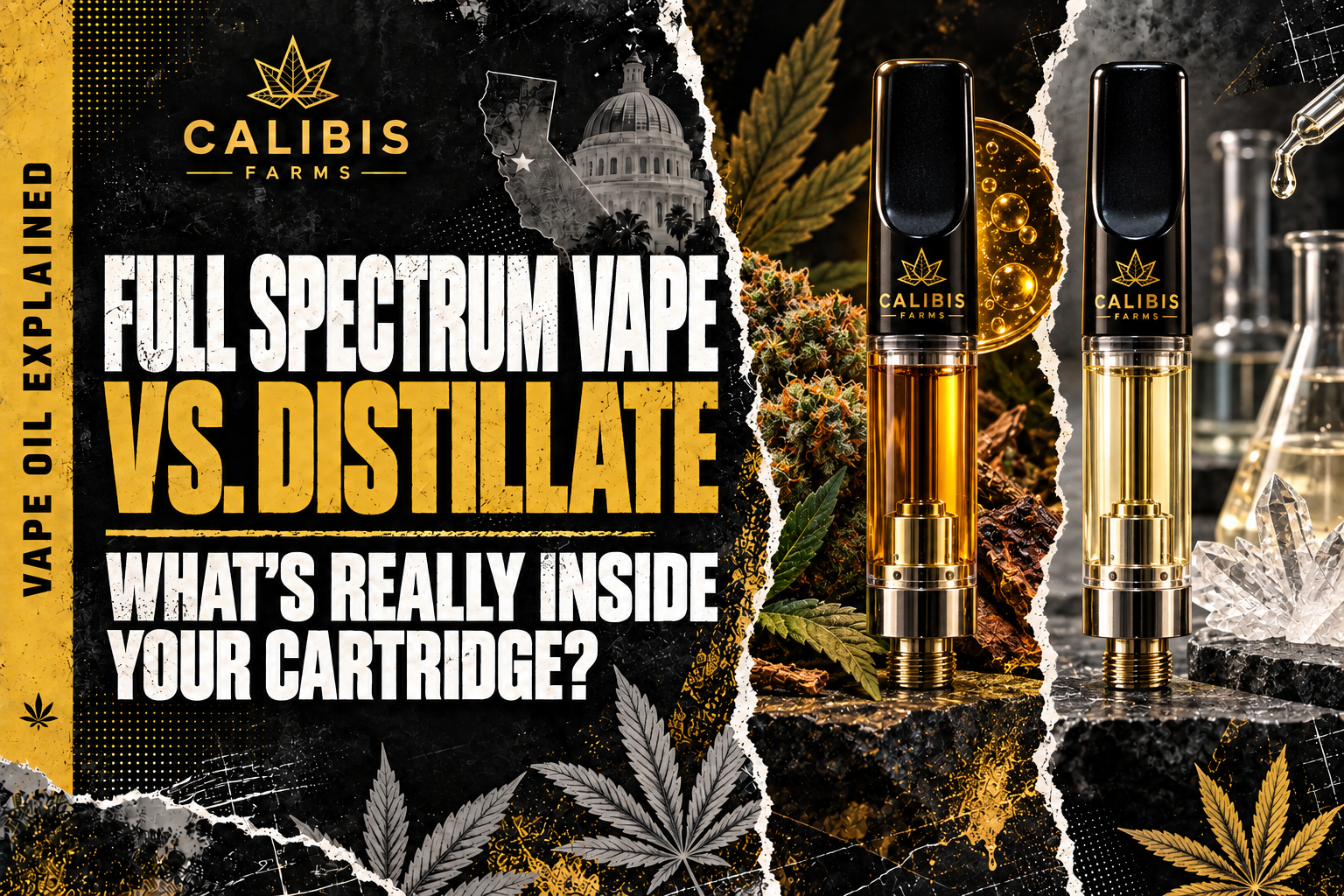
Full spectrum vape products and distillate cartridges can look almost identical on the shelf.
Same size. Similar THC numbers. Sometimes even similar flavors.
But what’s inside them can be completely different.
That difference starts with the oil.
In California, consumers are increasingly encountering terms like distillate, full-spectrum oil, live resin, cold terps, and cannabis-derived terpenes on vape packaging. Those words are not interchangeable, and understanding what they mean can tell you much more about a cartridge than THC percentage alone.
For Calibis Farms, that distinction matters because the character of a vape begins long before the oil reaches the hardware.
It starts with the cannabis itself.

Full Spectrum Vape vs. Distillate: Two Different Foundations
A vape cartridge is ultimately a delivery system.
Inside the cartridge is a cannabis extract formulated to vaporize at a controlled temperature. But there are many ways to create that extract, and those choices shape the flavor, aroma, consistency, and composition of the finished product.
One of the biggest distinctions is between distillate-based vapes and products made with a broader-spectrum cannabis extract.
Distillate is cannabis oil that has been heavily refined to isolate a target cannabinoid, most commonly THC. The process removes much of the original plant material and many of the compounds that naturally accompanied the cannabinoid in the source flower.
Full-spectrum products take a different approach.
Rather than focusing on isolating one compound as completely as possible, the goal is generally to retain a broader range of compounds from the source material.
That changes the conversation from:
How much THC is inside?
to:
What else from the plant made it into the final oil?
What Happens When Cannabis Becomes Distillate?
Distillate begins with cannabis extract, but it goes through additional refinement.
During distillation, compounds are separated using controlled heat and condensation. This allows processors to isolate cannabinoids such as THC at very high concentrations. If you want to understand how the condition of the flower changes extraction, our guide to cured resin vs. live resin explores that part of the process in more detail.
The resulting oil is typically:
- highly refined;
- relatively neutral in aroma and flavor;
- consistent from batch to batch;
- and well suited to different formulations.
That neutrality is part of distillate’s appeal.
Because much of the original terpene profile is removed during refinement, manufacturers can later formulate the oil with specific terpene blends and create very different flavor experiences from the same underlying cannabinoid base.
That is one reason distillate carts can range from cannabis-inspired profiles to intensely fruit-forward flavors.
Distillate is not automatically a lower-quality product.
It is simply a different type of starting point. That distinction is essential when comparing a distillate cartridge with a full spectrum vape.
So What Makes a Full Spectrum Vape?
“Full spectrum” is a broader term.
In cannabis, it generally describes extracts designed to retain a wider variety of compounds from the original plant rather than reducing the oil primarily to one isolated cannabinoid.
That can include combinations of:
- THC and other cannabinoids;
- naturally occurring terpenes;
- minor cannabinoids;
- and additional plant-derived compounds carried through the extraction process.
The exact composition varies depending on the flower, extraction method, batch, and formulation.
That’s important because full spectrum does not mean every compound from the original plant is present in exactly the same proportion.
It means the extract is attempting to preserve a broader chemical profile than highly refined distillate.
For vape consumers, the most noticeable difference is often flavor.
Why Can Full-Spectrum Vapes Taste More Like Flower?
‘
Flower has complexity.
A cannabis cultivar isn’t defined by THC alone. Its aroma can contain layers of citrus, gas, berry, pine, spice, earth, floral notes, or dozens of other characteristics.
Many of those characteristics are associated with the plant’s terpene profile.
When an extract preserves more of the source material’s natural aromatic compounds, the finished oil has a better opportunity to retain some of that cultivar-specific character.
This is one of the reasons full-spectrum and terpene-focused cartridges are often described as more flower-forward or true-to-strain.
At Calibis Farms, OG Grape Drip Cold Terps is a real example of that approach.
The cartridge is made with small-batch, full-spectrum cannabis oil and is designed to preserve the plant’s natural terpene profile. Its flavor profile combines grape, dark berry, and OG fuel characteristics rather than simply using potency as the product’s defining feature.
That’s a very different product philosophy from building a neutral distillate base and then deciding what flavor it should become.
Neither approach is inherently wrong.
They’re solving different problems.
Potency and Profile Are Not the Same Thing
This is where cannabis labels can become misleading.
Consumers often compare cartridges almost entirely by THC percentage.
An 89% cart looks stronger than an 82% cart.
Simple.
But potency does not describe the entire vape experience.
A THC percentage does not tell you:
- what the source flower was;
- which terpenes are present;
- how the oil was refined;
- what minor cannabinoids remain;
- what the product tastes like;
- or how well the hardware handles the oil.
Distillates can reach extremely high cannabinoid concentrations precisely because the process isolates the desired compound so efficiently. Weedmaps describes THC distillate as commonly reaching around 90% or higher purity.
A full spectrum vape may have a lower headline THC percentage while intentionally retaining more of the extract’s original chemical complexity.
That doesn’t automatically make it stronger.
And it doesn’t automatically make it weaker.
It makes the number less useful as a complete definition of quality.
Does Full Spectrum Mean Better?
No.
This is where cannabis education often becomes unnecessarily tribal.
Distillate has several real advantages.
Its neutral base provides manufacturers with significant control over consistency and flavor. It can also deliver very high cannabinoid concentration and help brands reproduce similar formulations across large numbers of units.
For consumers who prioritize predictable potency, bold formulated flavors, or consistency between batches, that can be exactly what they want.
A full spectrum vape appeals to a different priority.
They tend to make more sense for consumers interested in:
- the character of the original flower;
- terpene expression;
- cannabis-forward flavors;
- cultivar identity;
- and a less heavily isolated extract.
The better question is not:
Which one is objectively better?
It’s:
What kind of vape experience are you actually looking for?
Distillate Gives Brands More Freedom With Flavor
One of distillate’s most interesting advantages is flexibility.
Because the refined base is relatively neutral, terpenes can be reintroduced later in the formulation process.
That gives brands the ability to create profiles that are difficult to achieve by simply preserving the chemistry of one cannabis cultivar. Our guide to botanical vs. cannabis terpenes explains how the source of those aromatic compounds can shape the final flavor experience.
Think:
- mango;
- watermelon;
- strawberry;
- tropical blends;
- and citrus-forward profiles.
This helps explain why the vape category has developed into something much broader than a digital version of smoking flower.
Some consumers want their vape to remind them of cannabis.
Others want a completely different flavor experience.
Both can exist in the same category.
Full Spectrum Puts More Pressure on the Starting Material
There is another important difference.
If a brand wants the finished extract to reflect the source flower, then the quality of that flower becomes much harder to hide.
Genetics matter.
Cultivation matters.
Harvest matters.
Terpene expression matters.
The extractor can only preserve what exists in the starting material.
That is one reason sourcing matters so much to craft-oriented cannabis brands.
Calibis Farms describes its approach around relationships with trusted growers and manufacturers, with an emphasis on taking quality California flower and turning it into flavorful, consistent oil.
For a full spectrum vape, that relationship between farm and cartridge becomes especially important.
The finished vape is not completely separate from the flower.
It is an expression of it.
Hardware Still Matters Too
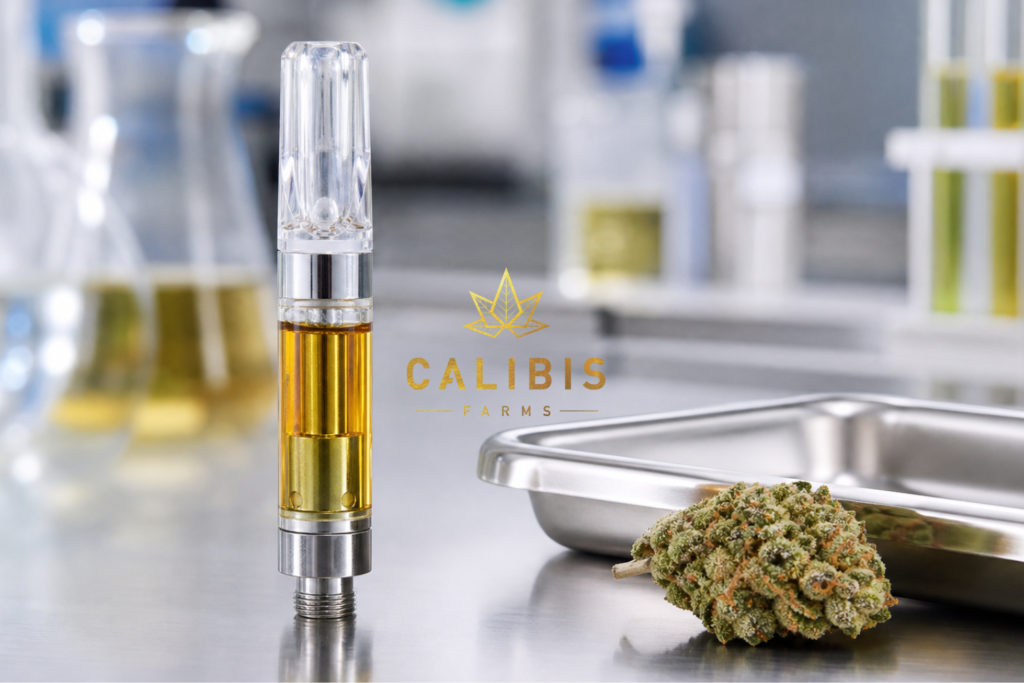
Oil is only half of the equation.
A well-made extract can still perform poorly if the hardware isn’t designed to handle its viscosity, airflow, and heating requirements.
Modern cartridges balance:
- temperature;
- coil material;
- airflow;
- oil saturation;
- battery output;
- and extract viscosity.
Our Cannabis Vape Guide explains why cartridges using similar oils can still perform very differently depending on how well the hardware manages heat and airflow.
That means two full-spectrum cartridges can still deliver very different experiences.
And the same is true for two distillate carts.
“Full spectrum” is not a shortcut for good manufacturing.
It’s one piece of the product.
How Can You Tell What You’re Actually Buying?
Start with the label and product description.
Look for language describing:
- Extract type: Does it say distillate, full spectrum, live resin, rosin, or something else?
- Terpenes: Does the brand explain whether they are cannabis-derived or botanical?
- Source material: Is there any information about the cultivar or flower?
- Testing: Legal California cannabis products should carry required testing and compliance information.
- Batch details: More transparent brands may offer batch-specific cannabinoid or terpene information.
The California Department of Cannabis Control requires cannabis batches to be tested before retail sale, including testing for cannabinoids, terpenes and contaminants.
And don’t assume that a higher THC number means a better cartridge.
A label should help explain what the product is trying to deliver.
Not just how much THC it contains.
Where Do Calibis Cold Terps Fit Into the Conversation?
Cold Terps sits on the flower-forward side of this discussion.
A full spectrum vape such as OG Grape Drip Cold Terps is made with small-batch full-spectrum cannabis oil and positioned around terpene preservation and cultivar character.
That means the story starts with the cannabis.
The goal is not simply to create the highest THC number possible.
It is to maintain more of what made the starting material interesting in the first place.
- Flavor.
- Aroma.
- Genetics.
- Terpene expression.
For consumers who care about those characteristics, the words on the cartridge matter.
What’s Really Inside Your Cartridge?
A full spectrum vape and distillate oil represent two different philosophies of vape formulation.
Distillate asks:
How cleanly can we isolate and control the cannabinoid base?
Full spectrum asks:
How much of the character of the original cannabis can we carry forward?
Both approaches can create quality products.
Both can create poor products.
The difference is not a simple hierarchy.
It’s about what is being preserved, what is being removed, and what is being rebuilt later.
That is why the best way to evaluate a cartridge is not to stare at one THC number.
Look at the entire product.
The oil.
The terpenes.
The hardware.
The source.
And the people who made it.
Because two cartridges can look exactly the same on the shelf.
What’s inside is where the real difference begins.